1. Composition and Architectural Characteristics of Fused Quartz
1.1 Amorphous Network and Thermal Stability

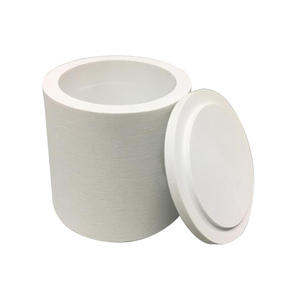
(Quartz Crucibles)
Quartz crucibles are high-temperature containers made from merged silica, a synthetic kind of silicon dioxide (SiO TWO) stemmed from the melting of natural quartz crystals at temperatures exceeding 1700 ° C.
Unlike crystalline quartz, integrated silica possesses an amorphous three-dimensional network of corner-sharing SiO four tetrahedra, which imparts exceptional thermal shock resistance and dimensional stability under fast temperature level modifications.
This disordered atomic framework protects against bosom along crystallographic aircrafts, making fused silica much less prone to splitting during thermal biking compared to polycrystalline porcelains.
The product displays a reduced coefficient of thermal growth (~ 0.5 × 10 ⁻⁶/ K), one of the most affordable among engineering materials, enabling it to endure severe thermal slopes without fracturing– a vital residential property in semiconductor and solar battery manufacturing.
Integrated silica additionally maintains excellent chemical inertness against a lot of acids, molten steels, and slags, although it can be slowly etched by hydrofluoric acid and hot phosphoric acid.
Its high conditioning point (~ 1600– 1730 ° C, depending on pureness and OH content) permits sustained operation at elevated temperature levels required for crystal development and steel refining procedures.
1.2 Purity Grading and Trace Element Control
The efficiency of quartz crucibles is very based on chemical pureness, specifically the concentration of metal contaminations such as iron, salt, potassium, aluminum, and titanium.
Also trace amounts (parts per million degree) of these contaminants can move right into molten silicon during crystal development, degrading the electric residential properties of the resulting semiconductor product.
High-purity qualities used in electronic devices manufacturing commonly contain over 99.95% SiO TWO, with alkali metal oxides restricted to less than 10 ppm and shift steels below 1 ppm.
Contaminations originate from raw quartz feedstock or handling devices and are reduced with mindful selection of mineral sources and purification techniques like acid leaching and flotation protection.
Furthermore, the hydroxyl (OH) content in fused silica influences its thermomechanical behavior; high-OH types use better UV transmission but lower thermal stability, while low-OH variations are favored for high-temperature applications due to lowered bubble development.
( Quartz Crucibles)
2. Production Refine and Microstructural Design
2.1 Electrofusion and Forming Strategies
Quartz crucibles are mainly created by means of electrofusion, a process in which high-purity quartz powder is fed into a revolving graphite mold and mildew within an electrical arc heater.
An electric arc produced between carbon electrodes thaws the quartz bits, which solidify layer by layer to form a smooth, dense crucible form.
This approach produces a fine-grained, homogeneous microstructure with minimal bubbles and striae, essential for uniform heat circulation and mechanical honesty.
Alternate approaches such as plasma combination and fire combination are utilized for specialized applications needing ultra-low contamination or particular wall surface thickness accounts.
After casting, the crucibles go through regulated cooling (annealing) to ease inner tensions and prevent spontaneous breaking during service.
Surface area completing, including grinding and brightening, guarantees dimensional accuracy and lowers nucleation sites for undesirable condensation throughout use.
2.2 Crystalline Layer Engineering and Opacity Control
A defining attribute of modern-day quartz crucibles, specifically those utilized in directional solidification of multicrystalline silicon, is the crafted internal layer framework.
During production, the inner surface area is often dealt with to promote the formation of a thin, regulated layer of cristobalite– a high-temperature polymorph of SiO ₂– upon first home heating.
This cristobalite layer acts as a diffusion obstacle, lowering direct communication between liquified silicon and the underlying integrated silica, consequently reducing oxygen and metallic contamination.
Moreover, the existence of this crystalline stage improves opacity, improving infrared radiation absorption and advertising more consistent temperature level circulation within the thaw.
Crucible designers carefully balance the thickness and connection of this layer to prevent spalling or cracking because of volume modifications throughout phase changes.
3. Useful Performance in High-Temperature Applications
3.1 Function in Silicon Crystal Growth Processes
Quartz crucibles are vital in the manufacturing of monocrystalline and multicrystalline silicon, serving as the primary container for liquified silicon in Czochralski (CZ) and directional solidification systems (DS).
In the CZ procedure, a seed crystal is dipped right into molten silicon held in a quartz crucible and slowly pulled upwards while turning, enabling single-crystal ingots to form.
Although the crucible does not directly call the growing crystal, interactions between molten silicon and SiO two wall surfaces cause oxygen dissolution into the thaw, which can influence carrier life time and mechanical toughness in completed wafers.
In DS processes for photovoltaic-grade silicon, large quartz crucibles make it possible for the controlled air conditioning of hundreds of kgs of molten silicon right into block-shaped ingots.
Here, coatings such as silicon nitride (Si six N FOUR) are put on the internal surface to stop attachment and promote easy launch of the strengthened silicon block after cooling down.
3.2 Degradation Systems and Service Life Limitations
Regardless of their robustness, quartz crucibles break down during repeated high-temperature cycles because of numerous interrelated systems.
Viscous flow or contortion takes place at prolonged direct exposure above 1400 ° C, leading to wall surface thinning and loss of geometric stability.
Re-crystallization of merged silica right into cristobalite creates internal stresses because of quantity development, possibly triggering splits or spallation that infect the melt.
Chemical disintegration emerges from decrease reactions between liquified silicon and SiO ₂: SiO TWO + Si → 2SiO(g), creating unstable silicon monoxide that runs away and deteriorates the crucible wall.
Bubble formation, driven by trapped gases or OH teams, even more endangers architectural strength and thermal conductivity.
These degradation paths limit the variety of reuse cycles and demand exact process control to make best use of crucible life expectancy and product return.
4. Arising Developments and Technological Adaptations
4.1 Coatings and Composite Modifications
To improve efficiency and durability, progressed quartz crucibles incorporate practical layers and composite structures.
Silicon-based anti-sticking layers and doped silica layers boost launch characteristics and lower oxygen outgassing throughout melting.
Some manufacturers integrate zirconia (ZrO TWO) particles into the crucible wall to boost mechanical toughness and resistance to devitrification.
Study is recurring into fully clear or gradient-structured crucibles created to optimize radiant heat transfer in next-generation solar heating system designs.
4.2 Sustainability and Recycling Challenges
With raising demand from the semiconductor and photovoltaic or pv markets, lasting use quartz crucibles has actually ended up being a priority.
Spent crucibles infected with silicon residue are difficult to recycle because of cross-contamination dangers, causing significant waste generation.
Efforts concentrate on developing recyclable crucible linings, enhanced cleansing methods, and closed-loop recycling systems to recoup high-purity silica for secondary applications.
As gadget effectiveness demand ever-higher product purity, the function of quartz crucibles will certainly remain to develop with technology in products scientific research and procedure engineering.
In recap, quartz crucibles represent a critical interface in between resources and high-performance digital items.
Their distinct combination of purity, thermal durability, and architectural design enables the construction of silicon-based technologies that power contemporary computing and renewable energy systems.
5. Supplier
Advanced Ceramics founded on October 17, 2012, is a high-tech enterprise committed to the research and development, production, processing, sales and technical services of ceramic relative materials such as Alumina Ceramic Balls. Our products includes but not limited to Boron Carbide Ceramic Products, Boron Nitride Ceramic Products, Silicon Carbide Ceramic Products, Silicon Nitride Ceramic Products, Zirconium Dioxide Ceramic Products, etc. If you are interested, please feel free to contact us.(nanotrun@yahoo.com)
Tags: quartz crucibles,fused quartz crucible,quartz crucible for silicon
All articles and pictures are from the Internet. If there are any copyright issues, please contact us in time to delete.
Inquiry us